


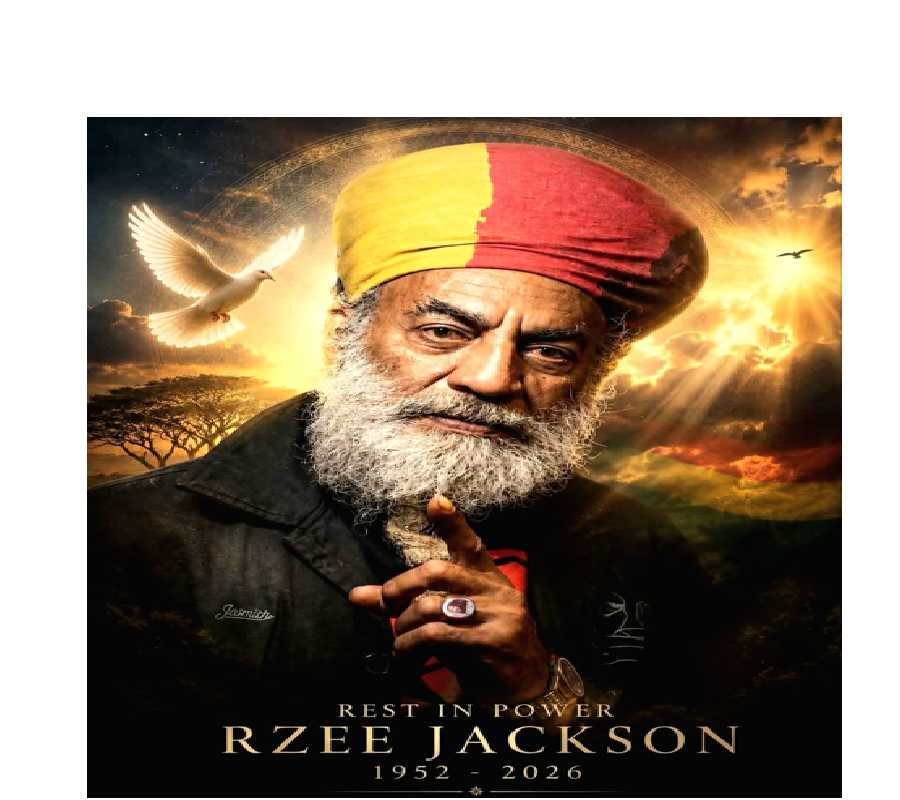
The reggae community in Canada and around the world is mourning the loss of one of its most influential pioneers. The family of Canadian reggae stalwart R. Zee Jackson, born June 23, 1954, has announced his passing on July 24, 2026. He was 72.
Known throughout his remarkable career as R. Zee Jackson, Esso Jaxxon and Castro Pink, Jackson was much more than a recording artist. A vocalist, percussionist, multi-instrumentalist, recording engineer, producer and music executive, he spent more than five decades helping shape reggae music in Canada while mentoring generations of artists. His family, including daughter Natania and his children Donovan, Tracy, Jr., Kareem, Mikhail, Malcolm, Nickal, Tamara, Tameka, Khouri and Maya, survive him.
Born in Clarendon, Jamaica, and raised in part in Old Harbour, St. Catherine, Jackson grew up immersed in the sounds of Jamaica’s vibrant sound system culture and witnessed the evolution of rocksteady into roots reggae. Those early influences would define a career dedicated not only to performing music but also to building the foundation that allowed reggae to flourish beyond Jamaica’s shores.
Jackson first travelled abroad in 1973 through a cultural exchange programme in the United States before making Toronto his permanent home in 1975. At a time when Caribbean immigration was transforming the city’s cultural landscape, he quickly became an integral part of the emerging reggae scene.
Working with producer Oswald Creary at Half Moon Studio and engineer Doug McClement at Comfort Sounds Studio, Jackson established himself as a respected studio musician and engineer. During this period, he formed lasting relationships with Jamaican music legends Jackie Mittoo, the former Studio One musical director, and Leroy Sibbles of The Heptones.
Sibbles later invited Jackson to join the Ital Groove Band, a defining chapter in his career. Jackson contributed as a harmony vocalist, conga and gong bap player, while also serving as the band’s recording engineer. When Sibbles pursued solo commitments, Jackson helped keep the group’s momentum alive through The Groove, also known as Jamafrica and Hit Squad.
Throughout the late 1970s and 1980s, Jackson became one of the driving forces behind Toronto’s rapidly growing reggae industry. Recording, engineering and producing several days each week, his work appeared on independent labels including BeeZee Sounds Production, Ital and Radio Plus.
His influence was especially significant along Eglinton Avenue West, where musicians, studios, record stores, restaurants and sound systems helped establish what would become internationally recognized as Little Jamaica. Jackson stood among the community builders who transformed the neighbourhood into one of North America’s most important reggae cultural hubs.
Encouraged by Jackie Mittoo to expand his reach internationally, Jackson travelled to London in 1980, where he collaborated with producer Mike Brooks on several dancehall and digital roots recordings. Songs such as “Ina South Africa,” which confronted apartheid, and “At the Reggae Party” demonstrated both his social consciousness and his understanding of sound system culture.
Recognizing that success in music required business knowledge as well as artistic ability, Jackson enrolled at Toronto’s Trebas Institute, graduating in 1996 with a degree in Music Business Administration. He later founded DubWorl Audio Visual HQ, worked with Imaaj Music and served as Vice President of Marketing for Kings of Kings Inc., further strengthening his impact on the reggae industry.
His connection to Jamaica’s roots reggae tradition remained unwavering. During the 2000s, Jackson reunited with longtime friend Cedric Myton of The Congos, working closely with the acclaimed group as a producer, musician and touring collaborator.
In recent years, his music found new audiences through reissues by labels such as Jamwax, which introduced classic recordings including “Long Long Time” and his interpretation of “Row Fisherman Row” to a new generation of vinyl collectors and reggae enthusiasts.
Those who knew Jackson often described him as a musical godfather and mentor whose influence extended far beyond the recording studio. His legacy lies not only in the music he created, but in the artists he encouraged, the recordings he engineered, the businesses he helped build and the role he played in establishing Toronto as one of reggae’s most important homes outside Jamaica.
His journey from rural Clarendon to the heart of Toronto’s Little Jamaica reflected reggae’s own global story—a music that transcended borders because people like R. Zee Jackson carried it with them wherever they went.
His passing marks the end of an extraordinary chapter in Canadian reggae history, but his contributions will continue to resonate through the artists, recordings and community he helped build.